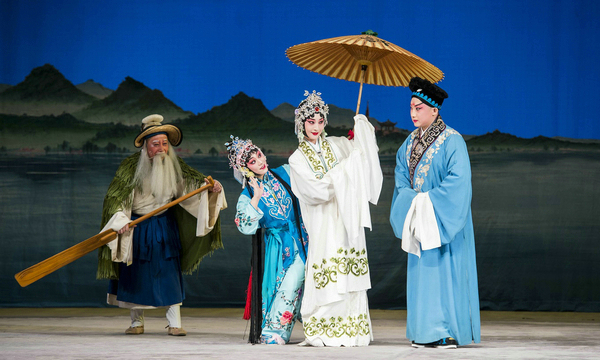
Legend of the White Snake
Introduction
The Legend of the White Snake is an enduring Chinese folk tale that has captivated audiences for centuries with its poignant narrative and rich cultural significance. At its core, the tale chronicles the love story between Bai Suzhen, a white snake spirit who transforms into a beautiful woman, and her human lover, Xu Xian. Set against the backdrop of mythical China, the story explores themes of love, sacrifice, and transformation. As one of China's Four Great Folktales, alongside other classics like Lady Meng Jiang and The Cowherd and the Weaver Girl, this legend remains a staple of Chinese culture, often adapted into various forms of literature, opera, film, and other performing arts.
Plot Summary
The Legend of the White Snake begins with the character Bai Suzhen, a snake spirit who has cultivated magical powers over centuries. Longing to experience human life, she transforms into a beautiful woman and encounters Xu Xian, a kind-hearted scholar. The two fall deeply in love and eventually marry, blissfully unaware of Bai's true nature. Their idyllic life together is disrupted by the intervention of Fa Hai, a Buddhist monk who believes Bai Suzhen's supernatural essence poses a threat. Fa Hai's machinations lead to a series of dramatic events, including Bai Suzhen's revelation as a snake and Xu Xian's subsequent death and resurrection through Bai's courage and love.
Main Characters
Bai Suzhen: The titular white snake spirit who transforms into a woman. Her dual nature as both a mystical being and a loving wife is central to the story's themes of transformation and sacrifice.
Xu Xian: A human scholar and doctor, who falls in love with Bai Suzhen. His character embodies innocence and devotion, pivotal to the progression of the tale.
Fa Hai: A Buddhist monk and antagonist who opposes the union of Bai Suzhen and Xu Xian. His actions instigate the conflict that drives the narrative.
Green Snake (Xiao Qing): Bai Suzhen's companion and confidante, who aids her in her endeavors and shares in her trials.
Influence on Literature and Performing Arts
The Legend of the White Snake transcends its origins as a simple folk tale to become a symbol of enduring love and sacrifice. It reflects the intertwining of the human and supernatural, illustrating the timeless struggle between desire and duty. The narrative serves as a vessel for exploring philosophical and ethical questions about identity, transformation, and the nature of true love.
The tale has inspired countless literary works, from ancient Chinese poetry to modern novels, capturing the imagination of writers and readers alike. It has been adapted into numerous forms, incorporating elements of fantasy, romance, and tragedy, making it a versatile and rich subject for exploration.
In the realm of performing arts, The Legend of the White Snake has left an indelible mark on traditional Chinese operas, including Peking Opera, Kunqu opera, and Yueju opera. These adaptations are celebrated for their dramatic presentation, elaborate costumes, and stylized movements, which bring to life the emotional depth and complexity of the original tale. The story's themes have also been explored through contemporary ballet and other dance forms, as seen in recent productions like the Guangzhou Ballet's adaptation.








